
 The Plan Commission set up a subcommittee in early 2008 that included the Building Commissioner, a representative from the Plan Commission, a representative from the Board of Zoning Appeals (BZA), a representative from the Town Council, a local contractor, a local realtor and a citizen/taxpayer. This subcommittee was tasked with reviewing the Zoning Ordinance and recommending changes to clean up past mistakes and to address changing issues. (Previously discussed here.) I was asked to serve on this subcommittee as a contractor, though like all the members, I also fell into the category of being a taxpayer in the district. The subcommittee spent nearly two years reviewing the existing ordinance. We literally read each line out loud, discussed it, discussed scenarios that had come before the Plan Commission or BZA regarding each section and then made a determination if changes were warranted. In some cases we even used word searches with the electronic copy to see where a reference might appear in other parts of the document. We actually eliminated quite a few definitions this way for words or phrases that never appeared in any of the rest of the document!
Zoning Lot – A tract or parcel of land designated by its owner or developer as a tract to be used, developed or built upon as a unit under single ownership or control. A zoning lot may or may not coincide with a lot of record.
In any district in which single-family dwellings are permitted, a single-family dwelling and customary accessory buildings may be erected on any single lot which has been recorded in the Marshall County Recorder’s Office prior to April 12 1983; provided, such lot is in separate ownership; and provided, such lot is not less than 5,000 square feet in area and 50 feet in width at the established building location and is served by both municipal sewer and water; and further provided, there is compliance with all other regulations contained in this ordinance and any other applicable ordinances, regulations, and/or codes of the Town of Culver. This section shall apply only to single-family dwellings. [Emphasis Added]

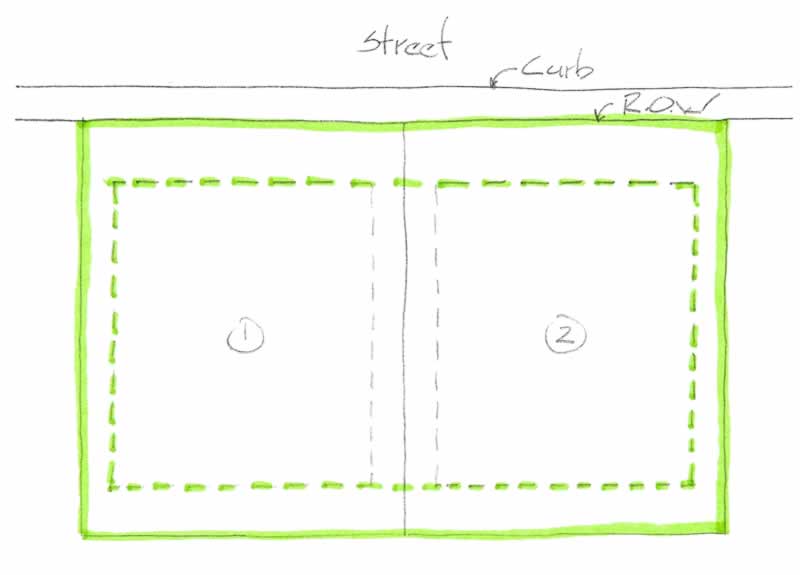
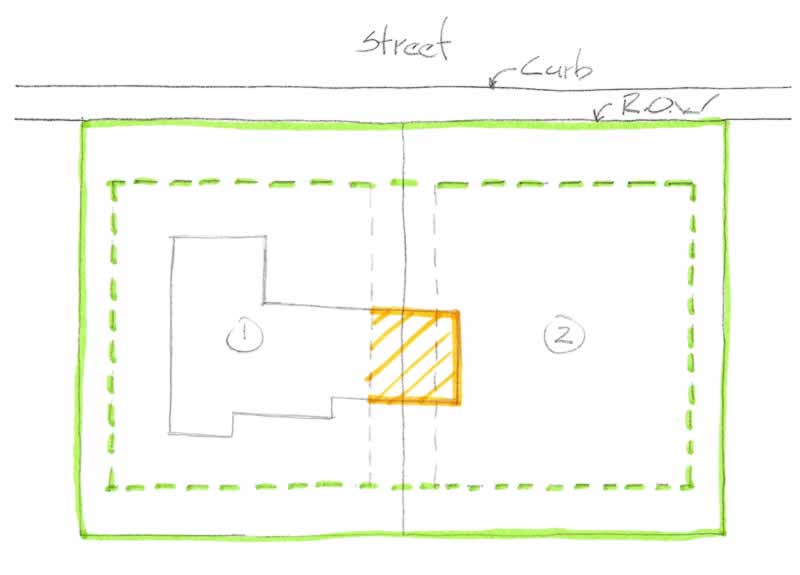
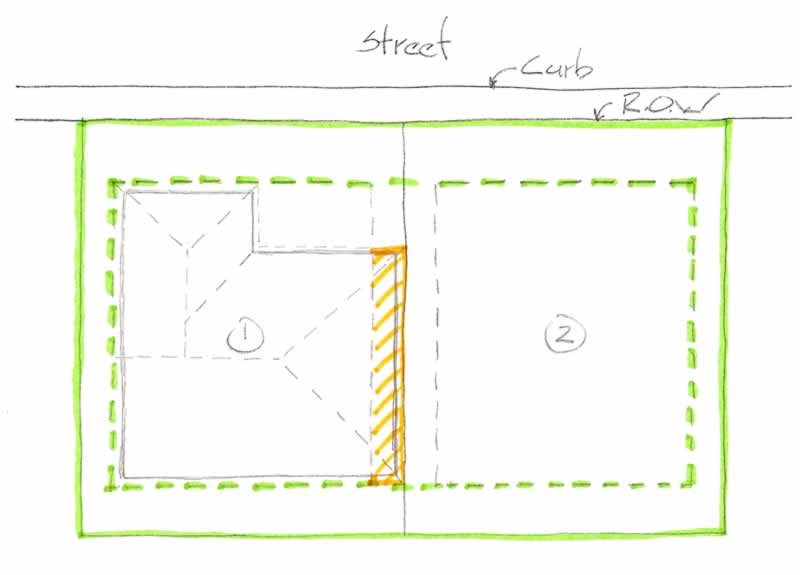
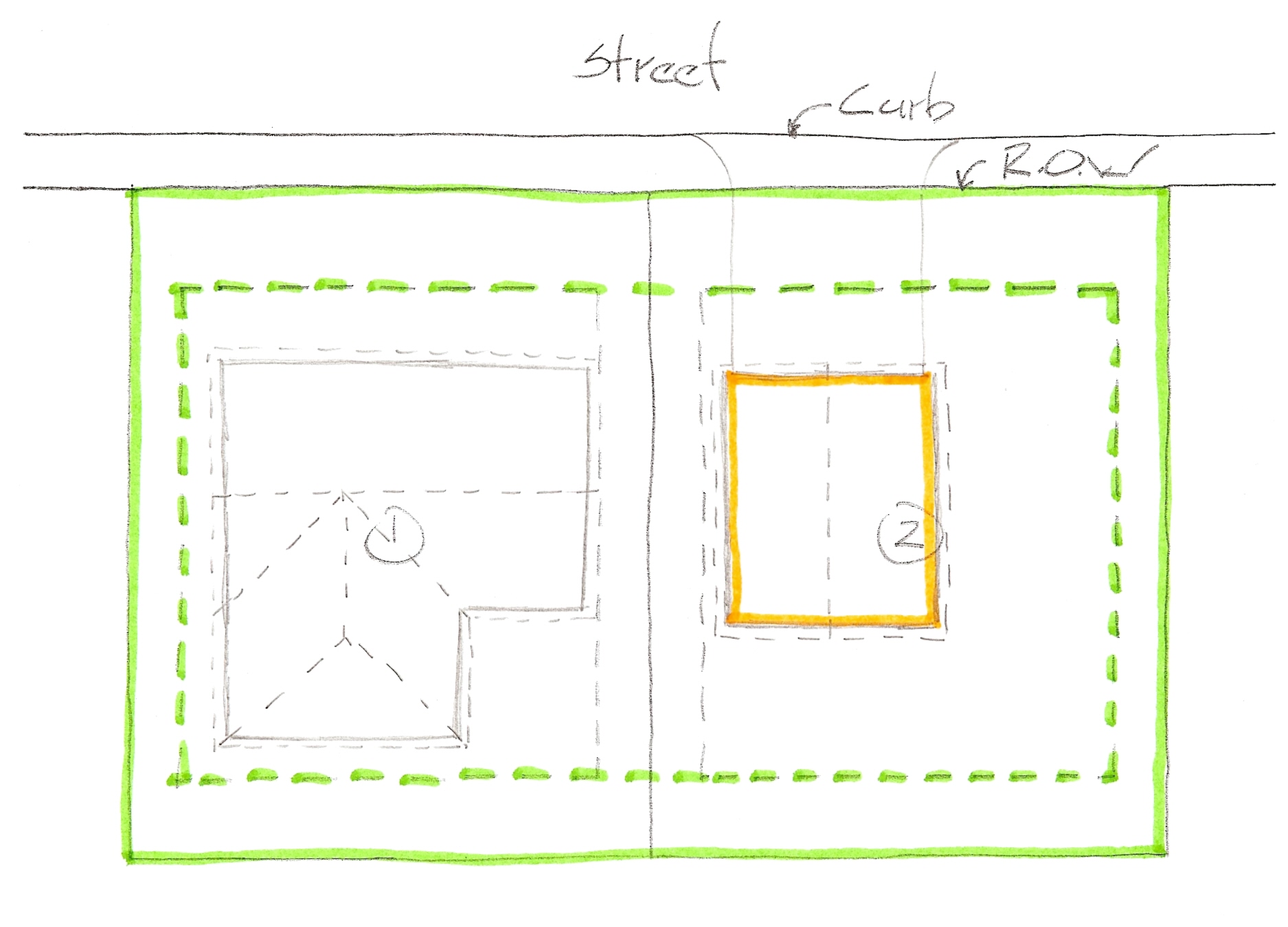
The property lines and setbacks highlighted in green become the governing requirements. The lot line and setbacks between the adjacent lots are no longer considered. This benefits the property owner allowing the entire property to be considered one lot without replatting or variances. The property owner may build across the intermediate setback lines and property lines. (Illustrations 3 & 4) They may have an accessory building (or a garage, a pool, a driveway, a parking area, etc.) on the adjacent lot. (Illustration 5) They also may consider the two lots as one for the purposes of calculating impervious surface. This provision in the ordinance has been used to the advantage of property owners for at least the past 27 years. Arguable, that does not make it right, but removing the provision will affect a large number of existing properties.
I am looking at the following issues:
- The existing language allows a property owner who has two or more contiguous parcels to call them one zoning lot and thereby void the interior lot lines and interior setbacks and build across them. (If they have two lots, they can build in the center of the two combined lots on top of the lot line.) If we take the language out, they will be required to replat those lots in order to eliminate the interior lines before they can build. This will require a survey, a new subdivision document and a hearing with the Plan Commission. All of which take time and money. Just the surveyor costs on a simple minor subdivision will run in the $1,000 range. (I checked with a local surveyor.)
- Removing this language makes every house in Culver that has already taken advantage of this language and violated those lot lines and setbacks to become a “non-conforming structure”. To make changes to a non-conforming structure requires a variance. This requires a trip to the BZA with all that entails. Again, this takes time and money. Their other option is to replat as described above, but that would generally be even more expensive and time consuming. (Currently because of the necessity to advertise these items twice in the Culver Citizen, if you need to appear before the Plan Commission or BZA you need to have all your documentation to the Town Hall just under a month in advance. If you miss that deadline, you are put off until the next month’s meeting.) A case such as this would have to prove a “hardship” to obtain a variance and that is always a coin toss with how the BZA feel about that and is subject to your neighbor’s input at those meetings.
- The issue with this that I’ve heard is that it is unfair that the lot can be sold and someone else could build on it when the current owner would be barred from building another residence on that lot because of the restriction against two dwellings on the same zoning lot. If second lot is “clean”, then it is extremely easy to work within the ordinance requirements. Here are just a few options:
- Set up an LLC, Trust or other entity to hold the adjacent property. Two Different Owners.
- Deed one lot to wife and one to husband. Two Different Owners.
- Deed one lot to parent and one to child. Two Different Owners.
- Sell second lot to builder or third party for $1 and buy it back for a buck after construction. We’ve been on projects with the Plymouth Schools (Kindt Soccerplex) and the Plymouth Parks Department (Young Amphitheatre) where this has been done. Two Different Owners.
- Sell the lot to a third party for $1 and retain a 99yr lease. Two Different Owners.
A comment was made regarding these options suggesting that they are “cheating” the ordinance. If anything, the “cheat” is the Zoning Lot provision as it now exists. It allows a property owner greater latitude in the use of the property without going through the lengthy and costly requirements of replatting the property as one parcel. But this cheat is a benefit to property owners that I would hate to take away.
With a little internet research I found that similar language appears in other Zoning Ordinances in our area:
Lot – A contiguous area of land separated from other areas of land by separate description for purpose of sale, lease, transfer of ownership or separate use. It may be a single parcel separately described or a combination of such parcels when adjacent to one another and used as one (1) lot.
Parent Tract: A lot of record as recorded (location, size, shape, etc) on the effective date of this Ordinance; or a lot as defined by its last conditional transfer of ownership by recorded contract transacted before the effective date of this Ordinance. Multiple lots that are contiguous and owned by one (1) person, persons in partnership, or a company and/or corporation(s) shall be considered one (1) Parent Tract for the purpose of calculating the amount of exempted splits allowed, yet each lot of record, as recorded by its own separate legal description prior to the effective date of this Ordinance, shall maintain its ability to be sold individually as a lot, but only as it corresponds to the said recorded legal description prior to the effective date of this Ordinance. Easements shall not constitute a separation of two (2) or more pieces of land owned by one (1) person, persons in partnership, or a company and/or corporation(s). A lot of record with an existing public road that splits it shall be considered two (2) parent tracts.
Marshall County Zoning Ordinance pg 294 (identical to Plymouth’s):
Lot – A contiguous area of land separated from other areas of land by separate description for purpose of sale, lease, transfer of ownership or separate use. It may be a single parcel separately described or a combination of such parcels when adjacent to one another and used as one (1) lot.

- Removing the provision would increase the workload of the Plan Commission and the BZA handling the non-conforming issues created properties that had taken advantage of the Zoning Lot provision over the past 27+ years.
- Removing the provision would increases costs to property owners for the additional Variances or Replattings that would be required.
- Is there a way to retain the language for existing properties while requiring replatting for new development on undeveloped lots?
- Does the Town Council have actual language they would like to see?
No resolution was obtained and it was determined to continue to wait for the Town Council’s direction. It was further discussed that there are many provisions that have been corrected in the ordinance revision that are going unaddressed while the portion in question is currently in effect under the current ordinance.